While Romanies in the English midlands town of Smethwick, near Birmingham, tell of Charlie Chaplin’s having been born there in the nearby “Black Patch” Romani camp, details of the famous actor’s origins remain elusive. In researching for his book on the area, historian Edward Rudge interviewed more than 30 Romanies and wrote that he “often heard the Chaplin story.” (1) This was corroborated in a faded document from Tamworth (also near Birmingham) sent to Chaplin in the 1970s and signed by a Romani man named Jack Hill, and which made the same claim. Chaplin’s oldest surviving son Michael, now in his sixties, and who has visited Black Patch, believes the letter to be authentic; he wrote “my father kept that letter locked in a bedside table and it was only discovered after my mother’s death, and long after his own death . . . the letter must have been significant for him to have kept it.” (2) It was inherited by his daughter Victoria following the death in 1991 of Chaplin’s wife Oona O’Neill, and was kept in the family vault in Montreux in France. (3) Chaplin’s birth certificate has never been found, and it has generally been assumed that he was born in London in 1889.
There has been speculation too regarding his ethnic background; by 1915 it had become widely accepted in America that he was Jewish; he even has an entry in Who’s Who in World Jewry, together with a spurious biography; when he appeared in the 1940 film The Great Dictator in which he played the part of a Hitler look-alike, that identity was further reinforced. All of his films were banned in Nazi Germany based on the same mistaken assumption. In the earliest versions of the screenplay his character’s identity is unspecified, and it is only in later rewrites of the script that it became Jewish.
Many of the books that deal with Charlie Chaplin’s life don’t mention his Romani connection at all; others, such as Sid Fleischman’s Charlie Chaplin, the Funniest Man Alive (4) include a single ‘Gypsy’ reference but focus on his Jewish connection. This was certainly deep and personal; his third wife Paulette Goddard (Levy) was Jewish (5), and he spoke often and passionately about the plight of the Jews in Europe. But he also made it clear in interviews and in his autobiography that he was not himself Jewish. His biographer Joyce Milton (6) wrote “I think awareness of his Romani heritage was an important part of Chaplin’s self-image and critical to his art . . . I suspect that Hitler’s persecution of the Gypsies was very much on Chaplin’s mind when he conceived the screenplay of The Great Dictator. However, he never said this publicly” (7).
Until they had a legal dispute over the authorship of that film (which he lost), Chaplin was closely involved professionally with a man named Konrad Bercovici (Berkowicz), a Romanian-born writer who has authored a number of fanciful books with a Romani theme (including The Story of the Gypsies and The Gypsy in Me). In an article that appeared in 1925, he stereotypically attributed some of Chaplin’s behaviour to his Romani ‘blood,’ claiming that “his great love for music, his great gift of improvisation and his instinctive familiarity with musical instruments pointed to gypsy origin . . . he is unable to stay in one place without coming and going . . . Charlie will suddenly begin to play his violin or dance and sing. Who else would do that but a gypsy?” (8)
Chaplin himself was devious about his background. He has said that he was born in France and that his mother was half Spanish; at other times that he was born in London. There’s even a vague suggestion that he was born in South Africa. To date, however, the only available information points to London as his place of birth.
Chaplin admits that when he was a child, references to any Romani ancestry were strictly downplayed, though this is predictable in families who have left that connection far behind them in the family tree. The genealogist Edward Ellis, who was the first to bring attention to the Jack Hill letter, suggested that Chaplin may have decided to lock it away not wanting his Romani connection to become widely known; (9) the increasing negative media attention being paid to Roma might certainly have become a factor in later years. Another Hollywood personality who spoke openly about his Romani ancestry during his early life but who became silent on the matter as his career progressed was Bob Hoskins. Chaplin was certainly not reluctant to talk about it as a younger man, and throughout his life would privately visit Romanies whenever he could. There are personal anecdotes and references in his papers to several visits he made to Roma during time spent in San Francisco, New York, England and France. For example, the British filmmaker Ivor Montagu, who was close to Chaplin in the late ’20s, said that he told him of visiting a “Gypsy fortune teller” who warned him that his third marriage would be an unhappy one (he and Paulette Goddard separated shortly after the appearance of The Great Dictator, and she married actor Burgess Meredith). His older brother Sydney married a woman known as “Gypsy,” whose family was from Budapest. In the 1970s his daughter Geraldine was guest of honour at a banquet hosted by Roma in Yugoslavia, and she acted the part of a Romani fortune teller in the 2010 film The Wolfman.
What is known with more certainty about his family is that his maternal grandfather was an itinerant shoemaker named Charles Frederick Hill who may have been Irish - though coincidentally he shares the same surname with that on the enigmatic letter - and whose grandmother’s maiden name was Mary Terry. A related figure, in whose home Chaplin’s mother Hannah sometimes lived after she and his father had separated when he was an infant, was a “general dealer” named John Hodges, perhaps a brother of Mary Terry's first husband, Henry, who died before she married Charles Hill.
Chaplin's father, also named Charles, died at the age of 37. He was the son of a Spencer Chaplin, who in October 30th 1854 married the seventeen-year-old Romani girl Ellen Elizabeth Smith in the Suffolk town of Ipswich. Although she died in 1873 long before Charlies Jr. was born, he wrote in his autobiography “Grandma was half Gypsy . . . I remember her as a bright little old lady who always greeted me effusively with baby talk.” (10) Unless he had Romani ancestry on both sides of his family, he was probably mistakenly referring to his maternal grandmother. John McCabe writes “Grandfather Hill’s wife was half Spanish, half Gypsy, the latter blood a well kept secret; Charlie did not reveal the fact until his middle age. The knowledge delighted him, as it would any artist.” (11) It is unlikely that Ellen was half Spanish. “Smith” is a common British Romani family name, but it is noteworthy that the Black Patch Romani community in Staffordshire were Smiths; the matriarch in the 1880s was Sentenia ‘Henty’ Smith, who died in 1907. There are Romani families today named Hill in Derbyshire and Yorkshire.
By Ian Hancock
Professor Ian Hancock OBE (Romani: Yanko le Redžosko) is a linguist, Romani scholar and political advocate, and is one of the main contributors in the academic field of Romani studies.
Many moons ago, when I was still in short trousers, my parents let me join the Cubs, the junior Boy Scouts. I learned nothing useful save how to tie the reef knot, essential for survival in the urban jungle, of course. But I enjoyed the Christmas Parties. The Cub leader would set up an ancient movie projector and show us the black and white films of his own childhood – Abbot and Costello, the Three Stooges, Laurel and Hardy and the greatest of them all, Charlie Chaplin.
I loved the little tramp with the baggy trousers and the lustrous eyes. Seeing my fascination, my parents let me into a secret. Charlie was almost a neighbour. He had been born in a gipsy caravan in Smethwick, a mile or so up the channel of the Hockley Brook. I knew the Hockley Brook, a smelly little stream that ran behind the houses at the bottom of my street, and it did come from Smethwick. But surely Charlie had to be American? I found out he was actually English, but hailed from London. As my parents had already misled me once – Father Christmas did not come down the chimney to deliver presents – I put this story down to an Old Wives Tale.
The fact that some of our neighbours also believed this improbable story did nothing to convince me. They added the fact that the place he was born was known as the Black Patch, but I was not to go there. The gipsies had been evicted long ago, but Smethwick was Black Country, and supported the Albion. Brummies did not go there. Smethwick had filth dating back to the industrial revolution. When I was growing up in the fifties, Britain still had heavy industry, coal fired and sooty, which was why the Black Country was black. There were no ironworks in Hockley, just light industry and canals and railway yards, so we looked down on the Black country as a dirty place with worse slums than the ones we were living in.
Later as a teenager studying O Level Social and Economic History, I found out why the Black Patch was called the Black Patch. One of the legendary places of the industrial revolution was the Soho Foundry of James Watt and Matthew Boulton where the first steam engines were made. And their works in Foundry Lane, Smethwick, had blast furnaces before the First World War, so the workers tipped the hot ash and slag onto the patch of ground opposite the factory gate to cool before being used as hard core. There was no grass, the ground remained scorched earth, and thus it was called the Black Patch. No one went there except gipsies until they were evicted in 1905. None of this made me think it could be the birthplace of a world famous star, and I forgot about the whole saga.
Fast forward half a century. I picked up a few facts about Chaplin’s life in England, discovering that his birthplace was mysterious, no birth certificate existed, and MI5 when asked to investigate Chaplin as part of the McCarthy investigations during the Cold War found nothing, save a rumour he was born in 1889, His mother Hannah Hill was a Music Hall singer with gipsy ancestry, but nothing firm was known about giving birth to Charlie. Smethwick and Hollywood seemed too far apart to be connected.
On Saturday July 25th I popped into a pub in the middle of Birmingham for lunch, and found a copy of that day’s Birmingham Mail left on the table. Inside was a double page spread with the headline, “Chaplin’s son to unveil memorial to Romany Gipsies at Black Patch”. Plus the sub heading “Experts 99.9% certain comic was born in Smethwick park”. The story which led Michael Chaplin to make a special visit from the south of France to unveil a plaque to the gipsies on the anniversary of their eviction was intriguing.
After Chaplin and his wife Oona died, his daughter Victoria inherited a writing desk with a locked compartment which could only be opened by a locksmith. Inside was a letter from a Romany called Jack Hill written in 1970 which criticised Chaplin for allowing mystery to circulate about his birth, and saying “You were born in a caravan, and so was I. It was a good one, it belonged to the gipsy Queen who was my auntie. You was born on the Black Patch in Smethwick near Birmingham so was I….” Chaplin had kept this letter locked away, and the fact he did not destroy it showed the letter was important to him.
Researchers found census data on a gipsy family called Hill who were on the Black Patch around this time, and the story was convincing enough to bring Michael Chaplin over from France. The Mail gave details of a ceremony next to the Hockley Brook the following afternoon. This was an invitation to savour and for the first time in my life I broke the taboo which means Villa supporters don’t go to Smethwick (though they can and do go to see the Albion, nice little ground – but it is in West Bromwich) and made my way to the Foundry Tavern which is directly opposite the Soho Foundry. It was not hard to think the ghosts of Boulton and Watt still visit to take care of business, though it is a factory for making scales and other weighing devices nowadays. And Chaplin? Does his spirit still go to the Black Patch?
The story that he was born as Jack Hill suggested is certainly not impossible, though no final piece of the jigsaw in the form of a document has ever been found, and is unlikely to be found as the gipsies don’t write down their history. But the letter is suggestive enough to have convinced Michael Chaplin, who at 69 flew in on a special visit to unveil a plaque to the Romanies who once lived on the Black Patch and probably cared for his grandmother.
As Michael Chaplin told the Mail reporter after the ceremony, “I think maybe he didn’t know where he was born because there was no registration, but maybe that letter coincided with something he’d heard himself. It’s highly possible that being alone she had no money and nowhere to go, and if she had a family contact up on the Black Patch maybe that was where she chose. The alternative was the workhouse and no-one wants to have a child in the workhouse, it can get taken away from you”. The story makes sense – and it was enough for Michael, to come to unveil a plaque that does not actually mention his father, in homage to the people he thinks took in his grandmother in her time of need.
The Black Patch is still a blasted heath, and the plaque by a bridge over the Hockley Brook is in a spot as remote as can be found in the middle of a built up area. This explains why the gipsies had been tolerated until they were evicted in 1905. Their history is known, if only in hostile giorgio records. If only the Brook could tell the stories of what it has witnessed, it might finally confirm the story told by my folks a mile and a half downstream seventy years later.
A century after the gipsies left the Black Patch, there is no way of ever knowing what happened while they lived on the site. But there is nothing to counter the story, and surrounded by the descendants of the Romany’s who had lived on the Patch on that Sunday, watching Michael Chaplin unveil the plaque, the folk memory passed down to me all those years ago seemed authentic. It still seems much more probable than it seemed in the days when Charlie Chaplin was a flickering image from an ancient movie projector keeping a group of young boys enthralled.
Trevor Fisher 3rd September 2015
Charlie Chaplin’s son delves into father’s gypsy past
Habib Koite and Sura Susso
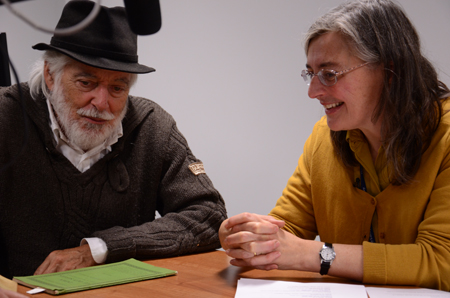
Michael Chaplin with Special Collections Librarian, Katy Hooper
Michael Chaplin, son of silent film great, Charlie Chaplin visited the University of Liverpool to shed light on his father’s Romany Gypsy past.
Michael, the second-born of eight from Charlie’s union with Oona O’Neill, spent the day in the Sydney Jones Library’s Special Collections and Archives, home to one of the largest depositories of Romany information in the world.
Sentina the gypsy queen
Michael, who spent much of his working career as a farmer in South West France, said: “A letter was written by Jack Hill to my father in 1971, after he had read my father’s autobiography, telling him he wasn’t truthful – but he can be forgiven – because of the claim he was born in Lambeth. The letter said this wasn’t true, that he was born in Black Patch in Smethwick in the caravan of the gypsy queen, Sentina.
“My father kept that letter locked in a bedside table and it was only discovered after my mother’s death, and long after his death.
“It’s caused a bit of a stir amongst the community around Black Patch and a lot of people who are biographers objected to taking this letter seriously. But we take it very seriously and are trying to find out as much as we can about Black Patch, and the Romany community.”
The pursuit is being turned into a film, provisionally entitled Caravan Trails – Charlie Chaplin The Untold Story, and Michael was joined on his visit by a cameraman who is chronicling his search for information. The visit to campus followed a trip to Black Patch.
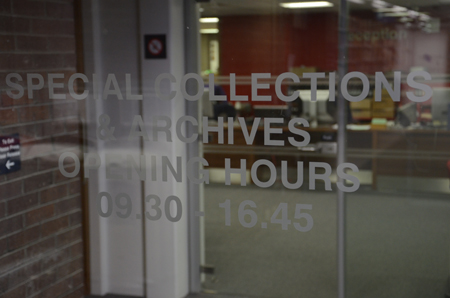
The Special Collections and Archives resource is home to one of the world’s largest collections of Romany material
Describing the Special Archives resource as a ‘gold mine of information,’ Michael said: “We’ve found out a lot about the Gypsy Lore Society and have gathered a good general picture of gypsy life. It’s been thoroughly enriching.”
A privileged childhood
Special Collections Librarian, Katy Hooper said: “The well-used Gypsy Lore Society archive gave Michael some contemporary references to the site where it is believed his father may have been born, and useful background on the history of Gypsy persecution.”
Speaking about growing up as the son of Charlie Chaplin, Michael said: “It had its great moments and its not so great moments. For me personally, it was a privileged childhood. We had a strong family, eight brothers and sisters, and he was fond of us all.”
Michael’s novel, The Fallen God will be published shortly.


